Dungeon Textures
Dungeon Textures
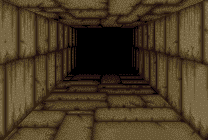
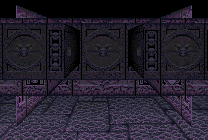
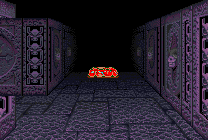
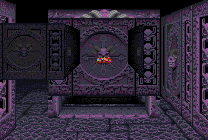
Section titled “Dungeon Textures”The three dungeon tilesets (bcdfx, bcdfy, bcdfz), shown through real,
208×140 first-person viewport renders produced by @seer/dungeon, the
same walker package that backs the interactive tools/walker/ harness. Served
from /assets/blackcrypt/amiga/textures/.
Each tileset is shown at its accent ramp, cycling through a handful of real poses picked from the actual explored maps (hover to pause):
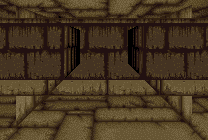
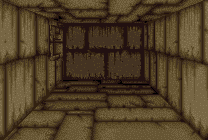
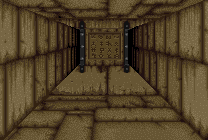
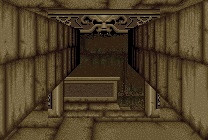
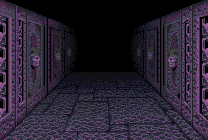
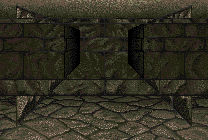
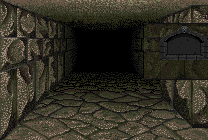
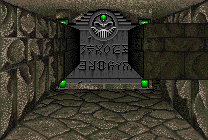
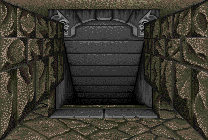
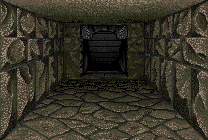
The raw atlas PNGs remain available in the repository’s extracted assets for inspecting individual sub-images.
Reading the tilesets
Section titled “Reading the tilesets”Each tileset is a bare concatenation of chunks whose directory lives in the
executable, not the file. The 84 named sub-images (47 for bcdfy) include side
walls, front walls, ceiling, floor, doors, pits, pillars, alcoves, plaques,
stairs, pull chains, panels, fountains and wall buttons. See
bcdfx/bcdfy/bcdfz.
These are real game output, not illustrations
Section titled “These are real game output, not illustrations”Earlier versions of this page showed hand-composited mockups: a script picked
plausible-looking dest positions and stacked a fixed “corridor + centrepiece”
layout together by hand, because at the time there was no working renderer to
produce actual game output. That’s no longer true. @seer/dungeon is now a
verified walker — it reproduces the game’s own view-geometry walk
(buildViewList), draw order (compositeDrawList/paintOrder) and indexed
palette compositing byte-for-byte, and every image above is that exact
pipeline run headlessly (www/scripts/render_dungeon_views.ts) against a real
(map, x, y, facing) pose from the actual exported dungeon data — the same
inputs tools/walker/ renders interactively in a browser. There is no
separate “illustration” step anymore: this page’s build now fails if the real
renderer fails.
Every pose below is reproducible: run the interactive harness
(npm run dev at the repo root, then open tools/walker/index.html with
these query params) and it renders the identical frame pixel-for-pixel.
bcdfx
| view | map | cell | facing | shows |
|---|---|---|---|---|
| corridor | bcdfb (map=1) |
(57, 1) | E | open corridor, side walls receding to a far wall |
| alcove | bcdfc (map=2) |
(35, 2) | W | a search alcove set into the left wall |
| plaque | bcdfd (map=3) |
(34, 1) | W | a wall plaque |
| stairs | bcdfc (map=2) |
(28, 24) | S | a stairway |
| door | bcdfc (map=2) |
(28, 21) | N | a locked door’s wall decoration |
bcdfy — this tileset’s own atlas (46 sub-images vs. 83 for bcdfx/bcdfz) has no alcove or plaque art at all, so its set shows a floor item instead — a real fact about the tileset’s art, not a gap in the walker:
| view | map | cell | facing | shows |
|---|---|---|---|---|
| corridor | bcdff (map=5) |
(45, 1) | E | open corridor, side walls receding to a far wall |
| floor-item | bcdff (map=5) |
(38, 4) | W | a floor item |
| stairs | bcdff (map=5) |
(1, 13) | E | a stairway, centred and close |
| door | bcdff (map=5) |
(3, 1) | E | a pull-chain door switch |
bcdfz
| view | map | cell | facing | shows |
|---|---|---|---|---|
| corridor | bcdfg (map=6) |
(43, 4) | E | open corridor, side walls receding to a far wall |
| alcove | bcdfg (map=6) |
(39, 5) | N | a search alcove |
| plaque | bcdfl (map=11) |
(8, 1) | W | a wall plaque |
| stairs | bcdfg (map=6) |
(9, 15) | S | a stairway |
| door | bcdfg (map=6) |
(9, 13) | N | a locked door’s ornate iron decoration, dead ahead |
Facings are N/E/S/W, matching the walker’s own 0/1/2/3
encoding and the harness’s facing URL param (e.g. ?map=1&x=57&y=1&facing=1
for the first bcdfx row).